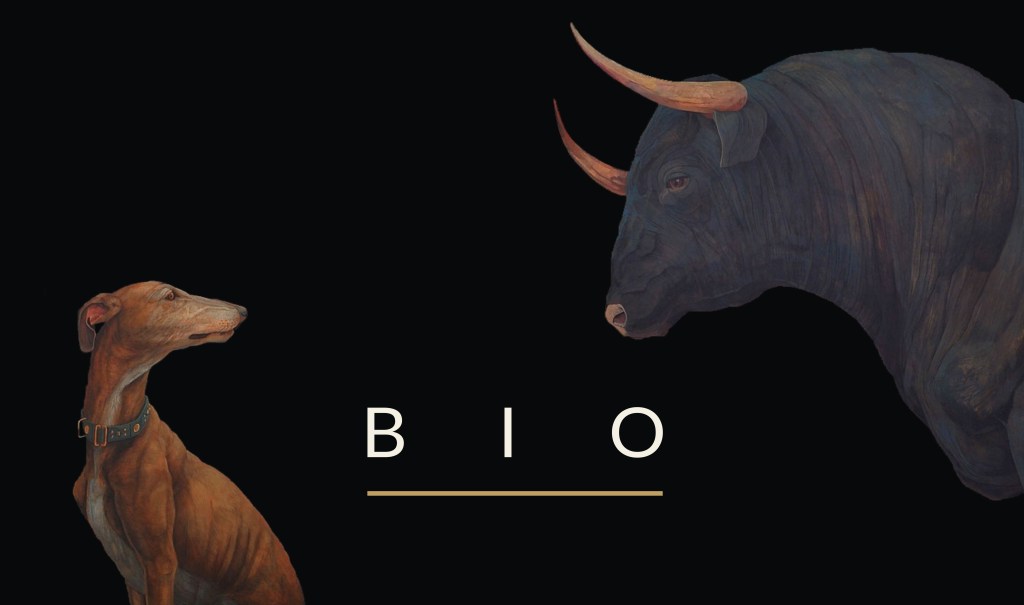
JEREMI P. LOREK
(born in 1993 Suwałki, Nothern Poland ) A graduate in master degree on the Academy of Fine Arts in Cracow, majoring in painting (2017).
Participant of exhibitions in Poland, Great Britain, Switzerland and Italy. Since 2018, he has been associated with Art Galleries in Cracow and Gdansk, where his works are sold to private collections in Poland and abroad.
His works show the artist’s interest in the 15th-century typography and his infatuation with old manuscripts, the idea and symbolism of the use of gold, illumination and the rules of proportion, often related to the theory of the Italian mathematician of the Middle Ages Fibonacci. Like the old masters, he searches for harmony, strives for perfection, tries to find a balance between the idea itself and the painterly means of expressing it.
Exhibitions:
- Chian Chiano Expo, Toscania, Italy, 2016.
- Group exhibition, II Floor Gallery, Cracow, Poland, 2017.
- Group exhibition “Vison”, Warsaw, Poland, 2017.
- Group exhibition “Vison”, Bern, Switzerland, 2017.
- Exhibition “Homage” Zofia Weiss Gallery, Cracow, Poland, 2017.
- Group exhibition “North – South “, Gdansk, Poland, 2026.
Publications:
- Avarage Art Magazine, London, October Issue, 2016.
- Museo Di Arte, Chian Chiano Expo, Italy, 2016.
C R I T I Q U E
Jeremi Paweł Lorek practices classical painting
If the key question of our contemporary times concerns individual modes of participation in culture, then the role of art is to offer us various answers. One of these is what, to distinguish it from post – or neo-avant-garde art, can be described as classical. It draws on the Renaissance model of the painting as a window onto the world, a reflection of an objectively existing system of values; an image realized according to specific rules, with an established code of communication with the viewer.
If, however, through the choice of this mode of participation we essentially define our own style of experiencing the world, then Jeremi Lorek’s painting precisely through the gesture of a manifest reference to tradition will propose content expressed through the harmony of beauty, goodness, and truth. Such universality is also embedded in context. Here, we are dealing not with a simple, purely formal return to proven principles of imagery, but with a sophisticated and reconsidered goal: to give us a long-forgotten sense of metaphysical fullness.
The Old Masters are a Symbol
Art is the proper combination of content and form, as a result of which ideas (objectively existing, and therefore understood in a Platonic manner) manifest in visible form. Their incomprehensibility and immateriality are replaced in the painting by symbols, which in turn reinforce the role of suggestion and understatement, which are essential here.
This idealism as a foundation for views on art united both the Renaissance and nineteenth-century Symbolism. Today, the baggage of theoretical and technical propositions from the entire history of art challenges us to make conscious choices of those tools that will express the artist’s intended message while simultaneously responding to the sensitivity of the contemporary viewer. Lorek uses this very understanding of art to hide behind content, for it transcends him. The paintings of the Krakow painter are the result of a search for the most appropriate formula for conveying the truth about the world, which he no longer individually creates, but which he accepts and gives to it visible form. The artist’s role in this arrangement is greater than it might seem, so Lorek fulfills his responsibility for the clarity of the message by employing classic tools: symbol, allegory, a composition stubbornly striving for the greatest possible symmetry and harmony, and finally, geometric perspective, which leaves no doubt that we are dealing with windows onto the reality of the truest values, realized only through our natural world. Thus, a single work encompasses a vision of spiritual content, to which we are led by the experience of the material world.
The artist creates a striking impression of timelessness through his clear references to the paintings of the Old Masters – it is impossible, looking at his paintings, not to recall the compositions of Uccello, Grünewald, Dürer, Holbein, and even Leonardo. These clear allusions – along with Latin inscriptions and the distinctly Italian foreground architecture against a curiously Northern European backdrop – are today a magnet; In an instant, we feel connected to our own European tradition at its peak, with its inherent content and points of reference. All this, combined with the unrealistic use of sharp chiaroscuro modeling and intense color, paralleling the experience of illustrativeness inherent in the contemporary iconosphere, creates the impression of experiencing, nomen omen, an illustration of the universality of certain truths, expressed in the poetics of the image.
Thus, the artist not only does not hide his inspirations but actually exposes them: aren’t the magic square and cubic solid, for example, a clear quote from Dürer’s Melancholia? This only underscores how much tradition is for him a subject of profound reflection and conscious development, not a contribution to simple imitation, aided only by modernizing devices. Moreover, the painterly vision and creative technique, unchanged in subsequent projects, testify to his complete conviction in the validity of his chosen path. These are certainly not paintings that explicate the artist’s fickle spirit. The consistently restrictive order in the sphere of composition, to which he himself submits while painting, takes on the value of a separate testimony to order as the principle of the content expressed here. Formal certainty here signifies spiritual certainty. This kind of content, too as when working on the technical aspect of a painting is reached through reflection and effort; not originating solely from within, it can only be realized in our response to it, which, in turn, when transferred to canvas, is intended to take on an objectifying dimension. It is precisely this desire to reveal a supraindividual truth, for which only an appropriate artistic equivalent is sought, that is the true reason for Jeremy Lorek work.
A Rebirth of Symbolism in Contemporary Times?
We are in a world beyond materiality, a world of ideas and values. Hence the symbolic status of formal arrangements, which are meant to indicate a meaning beyond themselves. The striking static nature of forms reveals the stability and permanence of the content behind them. If you look closely at the characters’ faces, you can quickly notice that their features are quite sharp, as if sculpted. “Classicism,” as a formula that today unites our visual associations with Renaissance and Classicist art, essentially refers to a concept of painting, every formal detail of which has a generalized and entirely extra-painterly dimension. This saturation with symbolism means that, in Lorek’s case, we are dealing with the classical painting of today par excellence.
This deliberate reference to tradition let us emphasize, both in the concept of the painting as an illustration of extra-painting content, in the sphere of analogous content, and finally in the area of what seems to be a clear result of these technical assumptions enables this work to immediately draw us in, naturally and seemingly effortlessly. As we begin to examine the canvases for a longer period, we experience the satisfaction of recognizing symbols so familiar to us: a skull, a scale, an hourglass, a dog, a pomegranate and immediate curiosity: for we also notice those we don’t associate so clearly, having been invented by the artist or intercepted and incorporated into a common language on the same principles as the previous ones (a sickle, a basket of apples, incense smoke, a corked bottle). A bridge is thus being built before our eyes, connecting us with the past, of which we are to be equal successors.
Furthermore, engaging in a skillful dialogue with the past is becoming a distinct art today. The artist’s proposition of individual symbols also expands his painterly vision with a freedom of imagination and individuality derived from the tradition of European Symbolism, but importantly, in its communal dimension. It is precisely this trust in what we primarily believe in, along with accepting reality in its broadest dimension and thus also in a dimension that eludes rational cognition and finally, emphasizing the intersubjective nature of these experiences, that is meant to lead us back to the moment when we feel that it is possible today to create art that is timeless, as significant as it once was, and thus perfectly suited to the multifaceted landscape of contemporary art.
This freedom of the artist also corresponds here with the freedom of perceptive interpretation. Not arbitrariness, but a degree of freedom that, while maintaining faith in the objectivity of the message, also allows us the opportunity for individual experience and the equal enrichment of the entire pictorial experience with our own associations. A work of art only fully exists with the participation of its viewers.
Jeremi Paweł Lorek’s artistic skill will thus be expressed in a unique balance of content and form, expressing the objective and the given and simultaneously the subjective and the experienced. This balance encompasses painting as a practice of making visible, along with what painting as an artistic process is meant to address a meaning that transcends the mere presence of form, and even the literalness of specific figures and the stories behind them. This balance also encompasses drawing on existing formulas for communicating with the viewer, while also carefully expanding them. Finally, he surprisingly realizes the avant-garde imperative to shock, yet also transcends it. The artist’s paintings leave us in a unique state, combining disbelief in the possible legibility of contemporary art with an unmistakable visual pleasure, sometimes difficult to accept within it.
A Surprising Proposal of Obviousness
These canvases also captivate us with their authenticity. Through their Latin titles, we see closer or more distant allusions to biblical and mythological themes (The Fruit of the Tree, The Queen of Sheba, Fate, but also: The Four Elements and The Four Corners of the World), which are treated in a generalized manner, as the most universal truths about the world—and these are precisely the truths in which the artist himself deeply believes. His paintings are therefore sui generis moral treatises. This decisive painting “in the style” of the early Renaissance from a moment just before the splintering of European art into distinct national trends is also an image of the existence of immutable, indelible truths in the world, impervious to epochal, even confessional, relativizations. It seems that today we are particularly in need of spiritual and intellectual recognition of this message through clear visual mediation.
In the painter’s work, form and content work closely together, ultimately offering us a proposal for defining a new community of perception. Practicing “classical” painting, Lorek also traditionally understands concepts (universality, truth, beauty, meaning). His belief in the constant constructive principle of the world is accompanied by a need to recognize what is truly good and ordered.
Even if contemporary philosophy has withdrawn from providing us with answers about what we should think about the world and forces us to decide our own individual values, he adopts a somewhat different approach to this issue, sketching in his art a brief outline of his entire worldview. His answers to timeless questions about happiness and the meaning of life, which happen to coincide with those known from tradition, because they are derived from the Bible, are not, however, simpler for that reason. Their difficulty manifests itself in the moment of exploration and individual realization of the values chosen in this – in this case, artistic – gesture. If we build the community of today on different principles than in the past – the mode of participation, not the content itself – then Lorek’s painting, by creating a transformative division (proposing a particular vision of the world), also outlines for us, the audience, the cultural framework for our functioning in the world. This painterly vision, drawing on a distinct myth of classical art, helps us to create and experience our identity today. We have long since forgotten that the harmony of painterly forms can visualize an objective harmony of values and simultaneously respond to our ineradicable need to experience a synchronicity between the external and the internal.
The Krakow artist is able to outline this community broadly. Beyond the method of participation itself, he also continues the traditional model of shared points of reference. Many will find something to enjoy here: admirers of the narrative painting of the old masters, those seeking aesthetic harmony, and finally, those who see art as a moment of transcending reality here and now, reassuring us that there exists a world of unchanging values, shared by all of us, both then and now. This includes those who believe in the content presented here, as well as those who seek it. Jeremi Lorek’s paintings will therefore give us back this extraordinary certainty that we lack most, and they will do so, moreover, by realizing the overarching principle of contemporary existence in society: boldly proposing his own image of the world.
Judyta Dąbrowska
Fine Arts and Literary Critic
Lecturer of the History Of Art at Jagiellonian University
Lorek is an artist of great talent and an eloquent communicator of ideas who pursues knowledge and the answers to complex conundrums through his artworks. Intense symbolism and powerful use of shape strikes the viewer who is subsequently absorbed in the delicate but effective vibrations of his colour palette. Lorek’s work ventures on a timeless journey with roots in the glorious artistry of the Renaissance age while simultaneously radiating with a sense of the avant-garde, a process in which this artist gives life to a crucial conjunction between ancient wisdoms and modern execution.
The ability to conceive mystery is also a fundamental element in Lorek’s
compositions and requires the observer to read, explore and interpret the
subliminal messages in order to penetrate the meanings expertly shrouded
with infinite intellectual and cultural references. Extraordinary skill and
talent combined with a mature artistic personality gives Lorek the ability
to translate aspects of a diverse and rich heritage of art history while
drawing inspiration from an eclectic range of styles. Classical and elegant
compositions inspired by Leonardo da Vinci juxtaposed with the sublime
and majestic grace reminiscent of Pre-Raphaelite philosophies are merged
with potent iconography in Lorek’s work. Every brushstroke is saturated
with implicit significance and explicit expressiveness that gradually
absorbs the viewer’s attention on a deep and subconscious level. The mind is stimulated by a reticent form of painting that becomes the undeniable means in which Lorek conveys his unique message. The rational element is constantly present and is perfectly balanced with the allusive enigmas that explode from each figurative representation as we concurrently enjoy references to Mondrian’s geometric studies, the delicate faces by Piero della Francesca and the Caravaggio’s chiaroscuro.
The complex simplicity of Lorek’s work is a wonderful paradox that raises as many questions as it answers: mystical and enigmatic themes, gentle female profiles and contrasting shades of exquisite and precious textures allow us to understand the talent of this artist and his intriguing capacity of painting subjects that stimulate elements of our unconscious minds. There is an indisputable logic and structure to Lorek’s work albeit the undeniable evocative and expressive nature of the artworks. The compositions convey Lorek’s eclecticism, his intellectual imagination and his profound desire to embrace the depths of an ancient awareness that is alive in his soul.
Lorek is an intricate painter that transcends a refined pictorial realism, communicating through a unique combination of inspirational sources resulting in an ingenious vision of an inherently timeless art.
Christopher Rosewood
International Confederation of Art Critics

