– ICOSAHEDRON –
The motif of a woman in art has many interpretations – some refer to a purely objective aspect, others and those closer to me, treat the female figure as an intermediary between the viewer and the content. A woman has the extraordinary ability to create life. It is the beginning, ensuring continuity. He feels reality deeper with sensitivity, she feels and experiences more with her instinct. In the symbolism of mysticism, she is the one who pursues the mystery. The perfect combination of a woman and a man creates wholeness – a state of cognition and understanding. One becomes the other. In the philosophy of gnosis and sacred geometry, a man may receive the highest level of initiation, he has to understand his feminine side. Get to know the world with the senses and sensitivity of a woman. Accepting this element leads to the achievement of internal balance. Usually, the concept of combining male and female features was expressed through the symbol of the hermaphrodite.
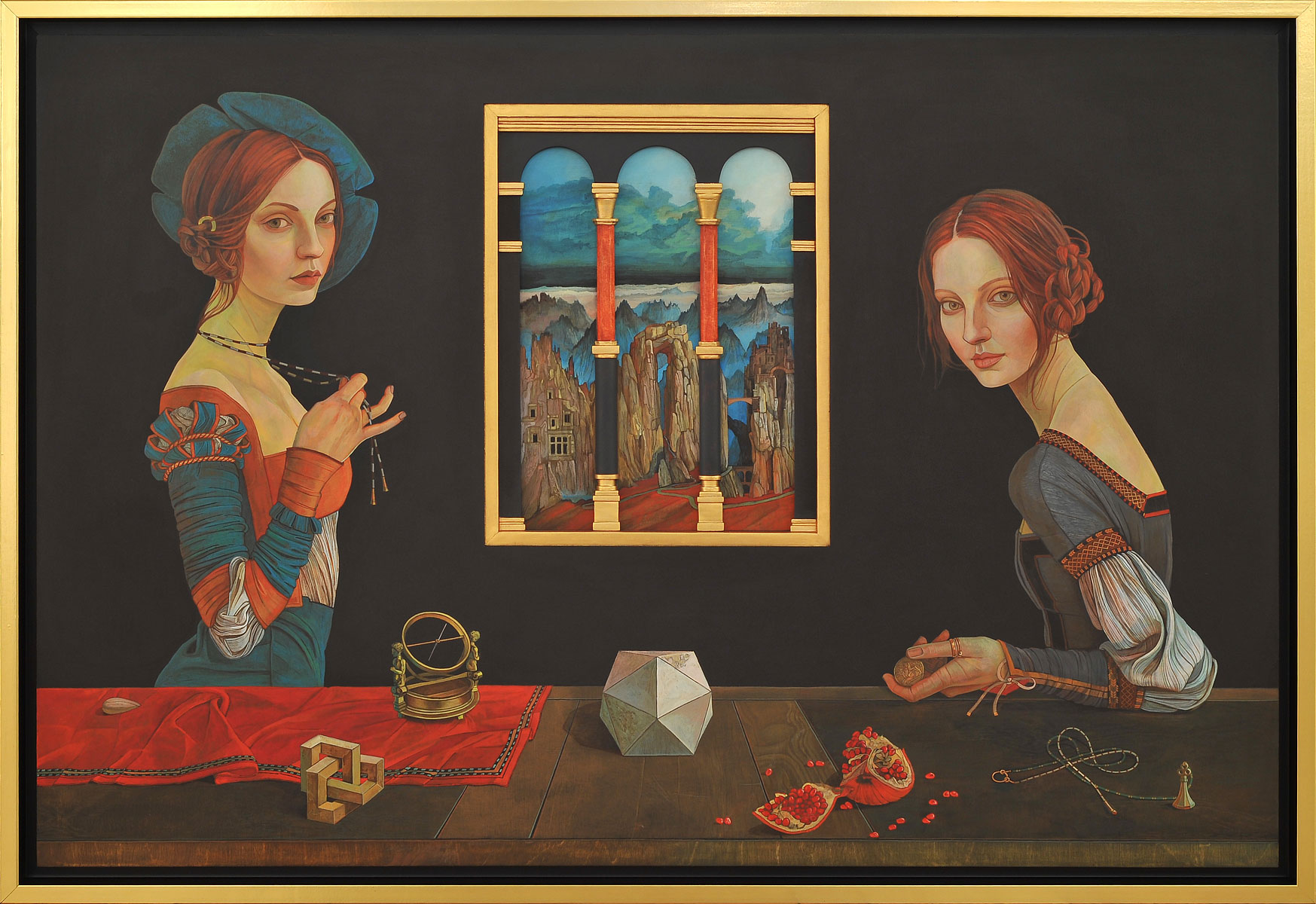
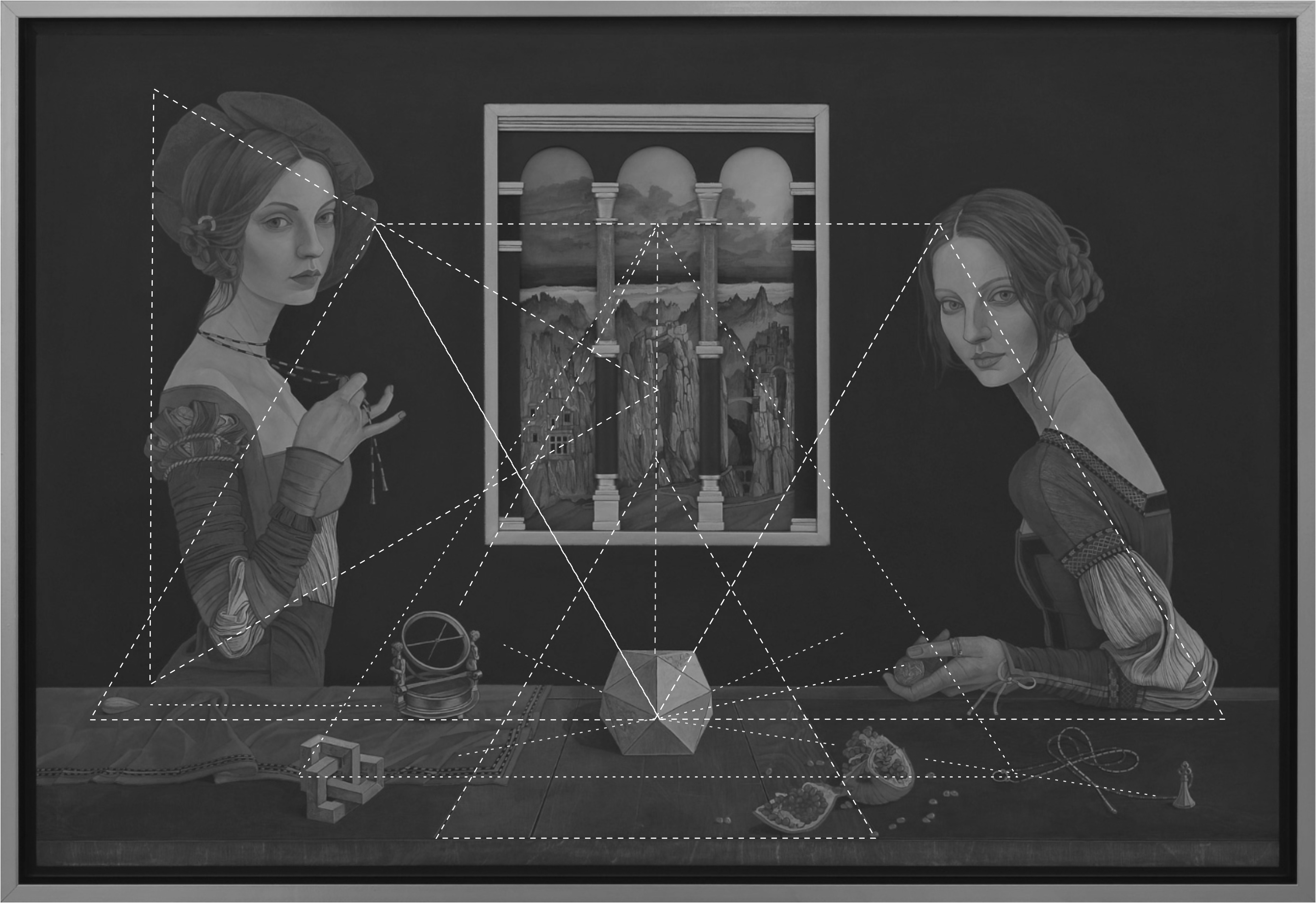
According to Ovid, Hermaphrodite, son of Hermes and Aphrodite, merged with the nymph Salmakis, resulting in a single person with male and female physical characteristics. However, it is not a biological feature but a symbolic one. The male nature, prone to conquest, destruction, war and competition, is the opposite of female nature, representing continuity, survival and creation. In my painting, a woman plays the role of the one who is curious, learns the reality intuitively and introduces them to the world of symbols. Her figure on the left side of the painting looks at the viewer thoughtfully and holds a black and white necklace between her fingers. The motif of white and black is also repeated on the scarlet tablecloth with an antique compass and almond seed on it. The compass needle glistening in the light points to the central part of the landscape, and the round shape of the almond completes the composition of the first triangle.
Almond seed
– in ancient times it was considered a pure fruit of nature and defined new life, spring awakening, beauty, hope, hidden spirituality and the oracle. Its wood was used to make scepters for kings, as it was believed that it had a mysterious power that passed on to the ruler. In Hebrew, almond also means “to keep watch” or “guardian.” The “watchful tree” is blooming 4 at the beginning of each year, sometimes during winter, and the abundance of flowers heralds the arrival of spring – a new cycle of life. The shape and form of the seed has a hard shell to protect the soft and sweet interior.
The chessboard theme
– the chessboard as a game is a reflection of human life – learning its rules and making decisions, we experience their consequences. The theme itself is so distant in the history of art that it is difficult to trace its beginning. One might assume that it is one of the first symbols that accompanies a person in his development. This is evidenced by the presence of the chessboard as an ornament in ancient Egypt, Iran, Greece and in every culture on all continents. It is a universal symbol of the duality of human nature. The internal conflict that creates awareness and identity. White and black, light and dark, life and death, soul and body, man and woman.
Triquetra
– in the painting hidden in an ashen-wood figure, consisting of intertwining rectangles. It is a summary of the collected symbols, an endless cycle, an interpretation of life and the difficulty of making choices. It defines the nature of man both in relation to himself and in relation to the surrounding reality. On the right side of the painting, a tilted female figure closes the third triangle with a slightly curved figure. The woman is facing the landscape and is holding a gold coin in her hand resting on the table.
Obol
in Greek mythology was a payment for Charon who transported the souls of the dead across the underground river Styx to Hades. The coin hidden in the shadow of the hand has the outline of the reverse of the griffin. Not without reason, as the neck is usually used 5 in symbolism as a guardian of an eternal mystery. In the back of the hand is a second oren with the symbol of harmony and happiness.
Eight
– in the painting it is made of bell strings, intertwined with each other. In philosophical terms, the eight is a combination of the impossible – four sides of the world with four dimensions. The number 8 stands for perfection and infinity. We find it already in the “State” of Plato or in the early stages of Christianity. The eighth day (after the six days of creation and the seventh day of rest) corresponds to eternity and “eternal happiness” (St. Augustine). It also means change, rebirth, new life. It is a direct response to human limitation – consciousness. The bell wakes us up from reflection with its bright vibrating sound.
Pomegranate
– symbolizes passion and emotionality. Its scattered seeds glisten with juicy flesh and contrast with the delicate gray of the wood. Pomegranate is a mystical fruit, untouchable during the Eleusinian mysteries. The bloody color of the flesh gives it the meaning of the fruit of life and death. The fruit itself contains a contradiction which explains its chthonic nature. The grain comes to life – it sprouts and gives a new life. Unlike the almond tree, the pomegranate is a fruit full of colors, flavors and multi-dimensional structures. In addition, in harmony with the almond tree, it creates the royal insignia – the almond as a scepter and the pomegranate as a fruit.
The central element of the painting is the figure of Pythagoras – “Icosahedron”, the shape of which is outlined in the warm light. It is directed at the viewer in such a way that the sum of his faces is a pentagon. The symbols and figures painted in the picture direct the shape towards the figure, complimenting its mathematical perfection and basing your composition on it. This makes every element of the picture 6 leads to the center of the pentagon. Its height runs towards the hidden meaning of the landscape.
The passing storm and the glow of the sun’s rays cut the naked rock peak from the cool background. A path meanders in a broken rock ceiling. In the left recess there is a city carved into the rock. Between the collapse of the rocks a mountain pass appears to the other side.
The composition ends with a rocky peak connected by three bridges. The landscape shows three paths to take – three choices, with a winding road crossing the beige-white red of the hills.
The painting is a reflection between emotion and thought, passion and logic – one complements the other, together striving for harmony.
 Jeremi Lorek