– MELANCHOLIA –
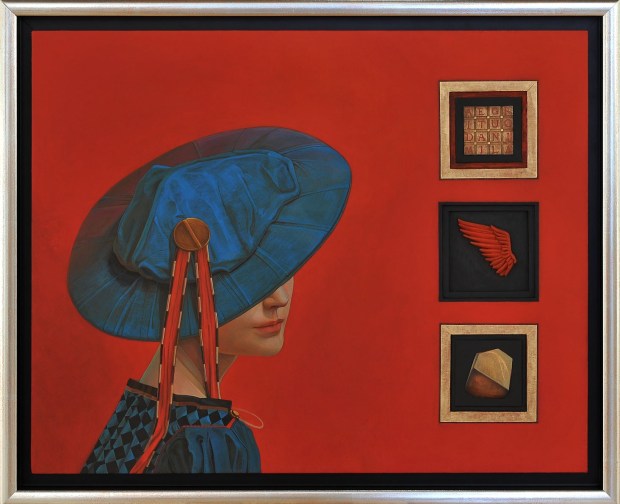
The painting was inspired by Albrecht Dürer’s “Melancholia I” print. Sadness and emptiness are visible in the hunched figure of an angel and in the falling dusk. An angel is unable to create, although he is surrounded by tools and instruments for artistic expression. Dürer metaphorically presented man’s powerlessness in the face of melancholy.
Aegritudo Animi
In Renaissance Europe, the term “Aegritudo Animi” was used to define melancholy, meaning the disease of the soul. For me, this is the price we pay for having awareness. For me, cognition is an act of self-awareness of the mind. At the meeting point of intellect and emotions, the soul appears as a pure and perfect form. In “Melancholy. A girl with a polyhedron ”the female figure has her face covered with a hat. It is unavailable. It separates itself from the viewer’s eyes with its brim – it is captured in an intimate moment of reflection. The woman looks towards the three squares on the right side of the painting. In the first square, which is a paraphrase of Dürer’s magic square, “Aegritudo Animi” and two other letters are inscribed. They form hidden anagrams. Below, in the middle square, the shape of a wing, symbolizing the elusiveness of an idea, a thought, emerges with the help of a strong blast of red. The shade of the color is combined with the symbolism and color of the background, creating a strong counterpoint in the black of the square. The last form is Dürer’s polyhedron, which is depicted as a philosopher’s stone. The symbol that opposes the values of the squares is a slightly glowing medallion, to which two red ribbons lead. They intersect the figure of a woman. The medallion is engraved with an octagon.
Octagon
(eight) placed on the hat symbolizes the quadrature of the circle. In philosophical terms, the octagon is a combination of the impossible – four sides of the world with four dimensions. The number 8 stands for perfection and infinity. We find it already in the “State” of Plato or in the early stages of Christianity. The eighth day (after the six days of creation and the seventh day of rest) corresponds to eternity and “eternal happiness” (St. Augustine). It also means change, rebirth, new life. It is a direct response to human limitation – consciousness.
Red colour
The red in the background, contrasting with the saturated blue of the hat, symbolizes the life and emotions that tear people in the moment of doubt. Red raises the brim of the hat and the secret hidden in a woman’s face. Blue color is a symbol of harmony and balance. My painting is an attempt to find an answer to the mystery hidden in the world and human life. It is an unfathomable mystery that is realized in the conscious observer.
 Jeremi Lorek